
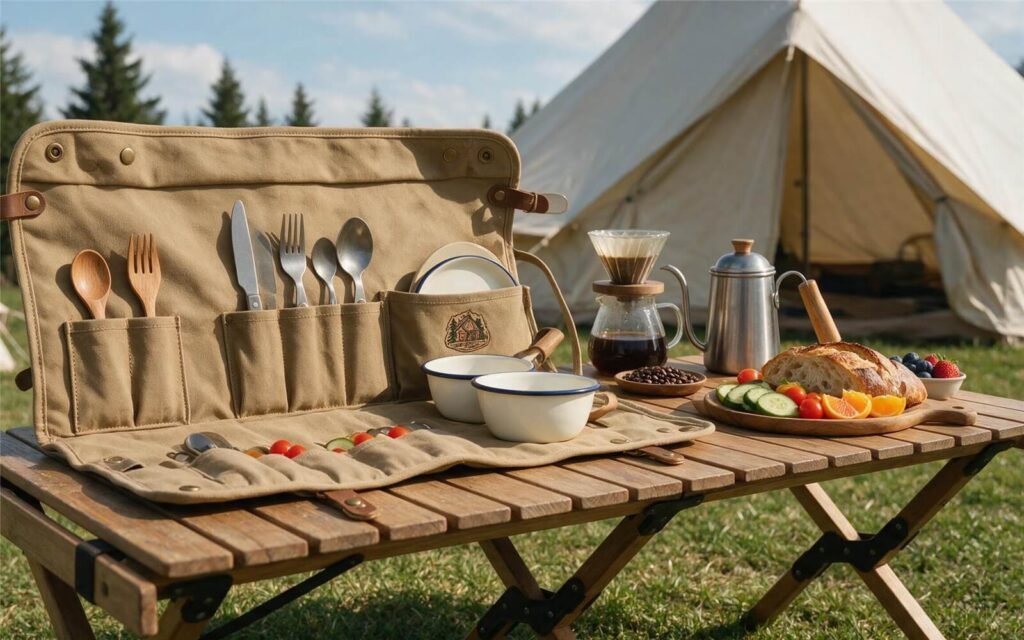
Camping-kitchen storage directly shapes the overall camping experience. Many campers struggle with messy utensils, spilled spices, digging through bags for small tools, or mold-prone gear after rain or spills.
Many outdoor brands design camping kitchen organizers focusing only on capacity and appearance, ignoring real-world camping workflows. Users follow a practical sequence: cooking, food prep, then storage. Poor compartment layout will generate negative reviews and high return rates.
Our factory has delivered OEM outdoor bags since 2014, serving dozens of global outdoor brands. Based on real-end-user pain points, this guide breaks down must-have features, scenario-driven design logic, fabric selection and common design mistakes, helping brand buyers avoid pitfalls and build competitive products. For alternative storage solutions, read our related article: Comparison of Camping Kitchen Storage Solutions.
1. Seven Must-Have Features of a Quality Camping Kitchen Organizer
1.1 Multi-compartment Layout with Dedicated Utensil Slots
User pain point: Knives, utensils, seasonings and cleaning supplies jumbled together. Sharp items scratch other gear; leaking bottles contaminate everything inside.
Core value: Modular divided layout with dedicated slots for utensils, spice bottles, knives and cleaning kits. Everything stays separated and easy to access.
1.2 Water-Resistant & Stain-Repellent Fabric
User pain point: Damp campsite ground, cooking spills, unexpected rain. Ordinary fabrics absorb grease, moisture and develop mildew.
Core value: Coated water-repellent fabric plus sealed edge treatment. Stains can be wiped clean easily.
1.3 Reinforced Base & Heavy-Duty Structure
User pain point: Bags sag heavily when loaded with glass spice bottles and metal cookware. Stress-point seams tear under weight.
Core value: Rigid reinforced base insert, double-stitching and bartack reinforcement on high-stress zones. The bag stands steadily and protects fragile contents.
1.4 Collapsible Flat-Pack Design
User pain point: Bulky storage when not camping; high volume increases logistic costs for overseas sellers.
Core value: Flattens down greatly for home storage and shipping.
1.5 Internal Securing Straps to Prevent Shifting Contents
User pain point: Bottles tip and leak during vehicle transport; cookware rattles and scratches each other.
Core value: Internal elastic straps hold bottles and cookware securely during bumpy transport.
1.6 Dual Carry Options: Reinforced Handle + Detachable Shoulder Strap
User pain point: Hand-carry only becomes tiring when fully loaded; poorly designed shoulder straps cause shoulder pressure.
Core value: Robust top handle plus adjustable detachable shoulder strap for flexible carrying options.
1.7 Quick-Access External Pockets
User pain point: Repeatedly opening the main compartment for wipes, bottle openers or small frequently-used items.
Core value: Outer pockets for fast-access small gear without disturbing internal organization.
2. Scenario-Driven Design: Match Real-World Camping Workflows
A good organizer is not defined by maximum compartments, but by fitting actual camping workflows. Below are six key design directions derived from global camper habits.
2.1 Align with the Three-Zone Camp-Kitchen Framework
User behavior: Experienced campers separate cooking zone, food-prep zone and storage zone to improve workflow and avoid cross-contamination.
Design insight: Internal compartments should map to these three functional zones. Removable modular dividers let end-users reconfigure layouts freely.
2.2 Tiered Product Lines for Different Trip Durations
- Overnight trips: ultra-compact, fast access is priority
- 2–3-night weekend camping: standard compartments for utensils and spices
- 7+ night base-camp camping: full-featured expandable layout including cleaning-kit storage
Design insight: Build tiered portfolio: lightweight entry-level model, mainstream weekend-camping model, expandable flagship for long base camps.
2.3 Follow the Frequency-of-Use Organization Principle
User habit: Organizing items by how often you use them works better than grouping purely by category. High-frequency gear sits within instant reach; rarely-used gear goes deeper inside.
Design insight: Place frequently-used utensils and spice slots near top-level or external quick-access pockets. Store backup tools in bottom compartments.
2.4 Vertical-Storage-Ready Structure for Small Campsites
User pain point: Limited table space on compact campsites; flat-laid organizers consume precious prep surface.
Design insight: Add top hanging attachment points for mounting on trees, vehicle tailgates or tarp poles, saving tabletop space. Upright slim profiles also suit small-tent setups.
2.5 Specialized Storage for Different Gear Categories
Dry goods need moisture protection; cookware needs scratch resistance; spices require leak resistance; cleaning supplies demand wet-dry separation.
Design insight: Apply different lining materials for different zones: spill-resistant fabric for spice sections, heavy-duty lining for cookware, isolated compartments for cleaning accessories.
2.6 Family & Group Camping: Safety-Oriented & Role-Based Layout
Scenario pain point: Multiple users share one bag; children near hot cooking zones create safety risks.
Design insight: Separate snack-access pockets for kids; safety latches for knife storage. Dual-bag sets, cooking kit plus food-supply kit, support divided-responsibility group camping.
3. Fabric Comparison for Different Brand Positioning
| Fabric Type | Performance Profile | Target Product Positioning |
|---|---|---|
| 600D Oxford with PU Coating | Cost-effective, balanced abrasion-resistance and water-repellent performance | Entry-level mass-market weekend-camping models |
| PVC Tarpaulin | Fully waterproof, wipe-clean, tear-resistant | Mid-high-end, rainy-climate and long-duration base-camp lines |
| 420D Nylon with TPU Coating | Lightweight, high-strength | Premium backpacking and minimalist-camping product lines |
4. Common Design Mistakes That Generate Poor Reviews
- Over-fragmented compartments: wasted internal space, cannot fit larger spice bottles.
- Waterproof fabric but untreated stitch holes: real-world rain-protection performance collapses.
- No reinforced base: bag sags heavily once loaded.
- Poor stain-resistance: fabric absorbs grease and looks worn quickly.
- Over-complicated folding mechanism: users avoid folding it.
- Compartment layout contradicts real cooking-workflow logic.
- Oversized dimension: impractical for compact campsites.
- No wet-dry separation: dry food risks contamination from cleaning supplies.
5. Cost-Effective Entry-Level Design Directions
Winning entry-level products do not rely on expensive raw materials. Smart structural design can solve core user pain points with restrained cost:
- Hanging multi-pocket layout
- Fold-out tool roll
- Basic three-zone divided interior
6. OEM Customization for Camping Kitchen Organizers
We support full-range customization to match diverse brand positioning and budgets:
- Custom capacity and dimensions: from compact portable models up to large family-sized units
- Internal-layout customization: add or remove dividers, utensil slots, securing straps and hanging points
- Material selection: oxford, nylon or PVC; adjustable waterproof-grade requirements
- Branding options: embroidery, screen-print, heat-transfer logo; custom Pantone color matching
- Tiered-product-line consulting: help brands build complete portfolios from entry-level to flagship
- Flexible MOQ: 100 pieces per model; 3-day sample turnaround for brand trial orders
- Compliance: products meet REACH and OEKO-TEX® standards for European-market access.
View more outdoor-bag customization solutions on our custom service page.
Final Thoughts
A high-quality camping kitchen organizer succeeds not merely through large capacity or numerous compartments, but by fitting real-world camping workflows and solving core user pain points under reasonable cost constraints.
For brand buyers, thoughtful scenario-oriented feature planning plus proper material-grade matching will reduce negative feedback, boost product premium and strengthen brand reputation. Contact us if you plan to launch camping-kitchen-organizer SKUs.
Frequently Asked Questions
